Eric Henty Fine Art
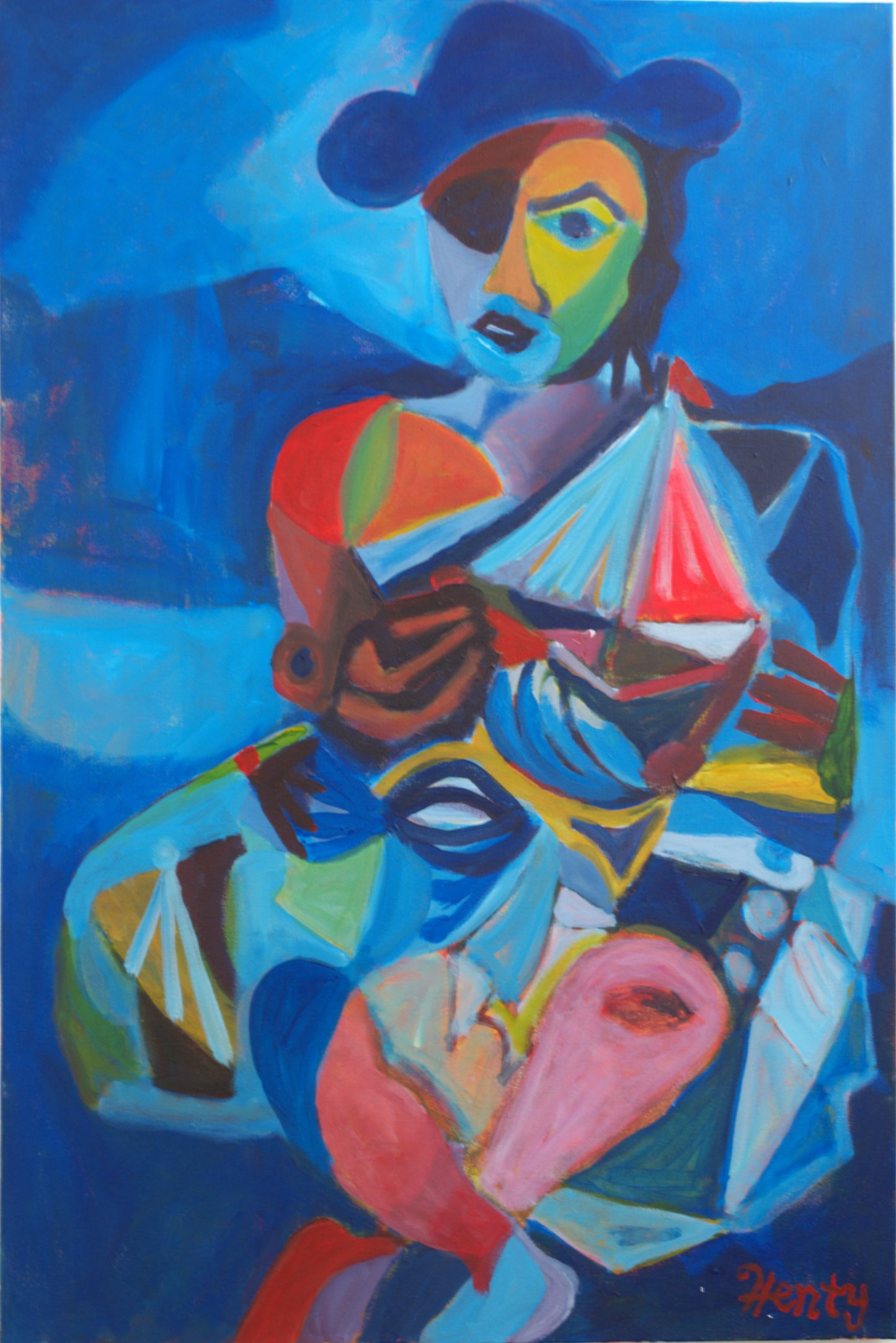
Midnight Sail, 24"x36", Acrylic on Canvas, 2025
Midnight Sail, 24"x36", Acrylic on Canvas, 2025
Couldn't load pickup availability
Midnight Sail portrays a solitary woman seated along a dark shoreline, illuminated not by earthly lamps but by the haunting blue radiance of the moon. The figure, dressed in luminous patches of orange, green, turquoise, rose, and ultramarine, seems almost charged by the night sky. Her form dissolves into expressive cubist planes, giving her presence the shimmering quality of a dream half remembered. She wears a broad, dark hat that casts her face into shadow, except for one sharply rendered eye—watchful, introspective, and alert. Cradled tightly in her hands is a small model sailboat, held with a tenderness and intensity unusual for an adult, as though the boat carries memory, longing, or a symbolic weight known only to her. Behind her, the moon hovers like an oracle. Its pale glow radiates outward in a triangular spill of cold light, cutting a sharp path across the mountainside and down into the water below. This celestial beam creates the structural backbone of the composition, pulling sky, land, and figure into a unified nocturnal geometry. The vantage point is slightly elevated, compressing her lower body and emphasizing her face, hands, and the symbolic boat. Henty’s Midnight Sail is a meditation on inner voyage and emotional navigation. The small sailboat—simple, fragile, held close to the chest—acts as a metaphor for the private journeys we carry within ourselves: childhood dreams, unspoken griefs, future hopes, or the longing for direction when life feels adrift. By placing this symbol in the arms of an adult woman, Henty creates a quiet emotional tension between maturity and innocence, reality and imagination. The woman’s vivid, youthful dress intensifies this contrast. Her garments appear almost like the clothing of a younger self—a palette of wonderment, play, and possibility. Yet her expression is somber, even contemplative, as though she is seeking guidance from the moonlit waters or perhaps returning to a place within her where she once felt safe. The moon, painted as a supernatural beacon, casts a triangular cascade of blue light that slices across the landscape. It becomes a symbolic path: a spiritual corridor, a guidepost, or a call toward deeper intuition. In this sense, the moon is not merely lighting the scene—it is illuminating the interior world of the sitter. Henty’s elevated perspective, the compressed proportions of the legs, and the abstracted shoreline all contribute to a sense of quiet unreality, as though the viewer is peering into a dream or memory rather than a literal scene. In Midnight Sail, night becomes a threshold. The figure sits not simply by the water, but between states of being—between past and future, childhood and adulthood, stillness and the impulse to journey onward.
Share